








MPs have moved a step closer to finalising the Pension Schemes Bill after the government used its majority to sweep aside more than 80 amendments put forward by the House of Lords.
It means the bill will retain a so-called “mandation” clause, granting the government powers to direct investments by defined contribution (DC) master trusts – albeit with a revised wording that aligns the clause with last year’s Mansion House Accord.
Other major amendments have also been rejected, including an attempt to change employer contribution rules for the Local Government Pension Scheme, and additional exemptions to the scale requirement that means multi-employer DC providers must reach £25bn in size by 2035.

Torsten Bell, the pensions minister, again outlined a perceived “collective action problem” that the mandation clause is designed to address. He indicated that a focus on cost had meant less investment in some asset classes that were more expensive but could deliver higher returns.
Rejecting the House of Lords’ amendments removing the mandation clause, Bell said: “To do so would be to let savers down, to ignore the strong consensus about what is in savers’ interests, and to disregard the barriers that we all know are holding back delivery on that consensus.”
The government tabled, and the Commons passed, an alternative wording for the mandation clause to limit any requirement to no more than 10% of assets to be held in “qualifying assets” – broadly speaking, private markets – and no more than half of that in the UK.
Bell said the new wording also meant that any regulations implementing this “reserve power” would have to be “entirely neutral between asset classes”, a move designed to address concerns that ministers could direct investments into specific areas.
Mandation issue still unresolved, say Conservatives
In response, shadow work and pensions secretary Helen Whately highlighted multiple defeats for the government in votes in the House of Lords, including over mandation, as well as the overwhelming industry opposition to the reserve power.
The Conservatives have pledged to repeal the measure if they win the next election.
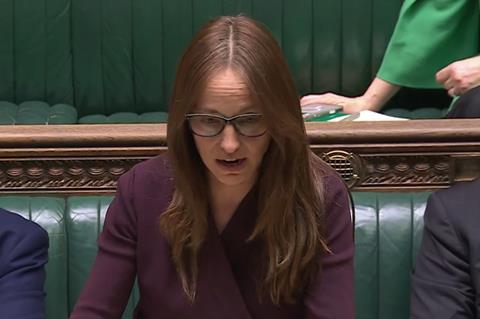
While acknowledging the government’s move to align the power with the Mansion House Accord, Whately argued: “The fundamental problem remains unresolved, however, because at its core, the bill still gives the government the power to direct the investment of people’s pension savings, and that, as a matter of principle, is wrong…
“It is true that this is a little less bad, but let me be clear: if this is wrong in principle, it does not become right in small doses.”
Fellow Conservative MP Katie Lam described the mandation power as “a shocking power grab” and “totally indefensible”.
Steve Darling, the Liberal Democrats’ spokesperson on pensions, added: “It is right that the state should encourage investors, suggest where they should go, and have appropriate schemes to guide them, but the idea of direction is anathema to us… Mandation is the dead hand of government on growth, for people’s pensions particularly, and it goes against our free-economy approach.
“In two or three years’ time, we may have a new government in post, and we need only look at the other side of the Atlantic to see what democracy can throw up. We could be giving a future government, whose colour we do not know, [power to direct investments]. Any reassurances that the minister gives would not be worth the candle then. We fear that going ahead with mandation would be feckless and dangerous for our pensioners.”