










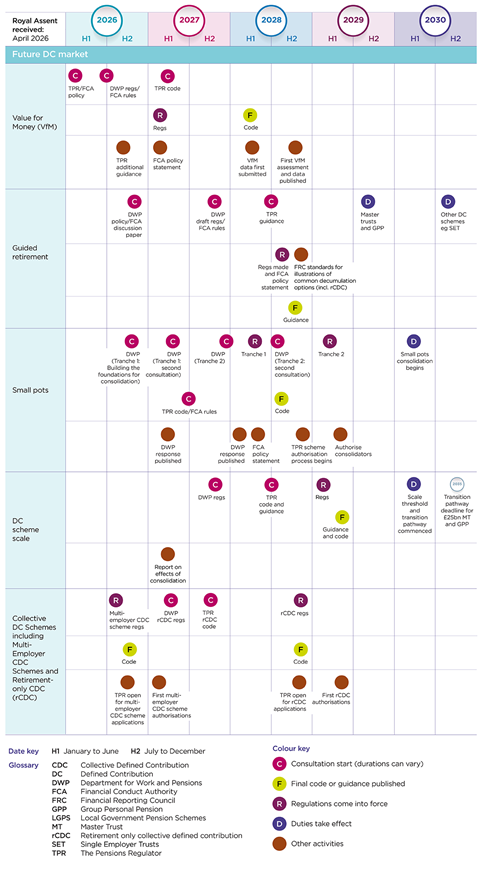
From Value for Money to surplus release via scale and consolidation discussions and levy arguments, last week’s roadmap announcement has given the pensions industry a lot to think about.
Speaking at Mansion House in front of industry representatives and journalists, pensions minister Torsten Bell – in what could be his final address in his current role ahead of an anticipated government reshuffle – said the government had responded to concerns about implementation but would not allow projects to drift too far.
“There is not going to be a world in which people say, ‘I’d rather not be producing the information on that timeline’. We are going to deliver this,” he said.
The roadmap has been developed by the Department for Work and Pensions in collaboration with the Treasury, the Financial Conduct Authority, and the Pensions Regulator, in an effort to ensure reforms are implemented efficiently and cohesively.
Use the links below to navigate to the different areas of reform, where Pensions Expert has summarised the documents, collated reactions, and provided links to related coverage.
Previous implementation dates for the superfund regime and the Value for Money framework have been pushed back, as has guided retirement. The latter has been moved to align it with the regulations for multi-employer collective defined contribution (CDC) schemes, as some providers plan to use CDC as a decumulation option.
Alongside the new roadmap, the government also published a range of other documents and consultations on various aspects of reform, including Value for Money, defined benefit (DB) surplus use, and superfunds.
Mapping the next five years of reforms
Industry hails cohesive planning approach
The Society of Pension Professionals (SPP) said the plan was an “important opportunity to bring greater certainty to one of the most ambitious periods of pension reform in decades”.

Gareth Stears, deputy chair of the SPP’s administration committee, said: “The pensions industry has never shied away from change, but the volume of reforms currently in train shows clear planning is more important than ever…
“If the government can maintain a clear sequence of reforms, avoid unnecessary changes of direction and allow sufficient implementation time, the industry will be in a much stronger position to deliver lasting improvements for pension savers.”
Jamie Jenkins, director of policy at Royal London, urged the government to pause any further changes to policy that could affect the pensions sector.
“These changes [in the roadmap] are being introduced when a number of other major reforms are already in the pipeline, including changes to the inheritance tax treatment of pensions next year, the rise in the minimum pension age in 2028 and the salary sacrifice cap in 2029,” Jenkins said.
“As the industry works through this substantial programme of reform, we would encourage the government to avoid introducing further changes to private pensions, enabling providers to focus on implementing existing reforms effectively and helping savers to navigate an increasingly complex retirement landscape with confidence.”
“Pensions policy requires long-term thinking and consistency, and pension schemes, employers and savers need confidence that reforms will be seen through and that decisions are being made with long-term retirement outcomes in mind. The minister has done his best to chart a clear course ahead.”

Kate Smith, head of pensions at Aegon, added: “Publishing the roadmap opens up a vital opportunity for discussion, for industry agreement and alignment on the most effective way forward and, ultimately, for the improvement of outcomes for our customers.”
James Carter, head of platform policy at Fidelity International, hailed the collaboration between regulators and government departments on the roadmap, which he said would be “crucial” to the success of the reforms.
RSM warns on reforms and reshuffles

With Andy Burnham taking over as prime minister today (20 July), there is much speculation about a potential cabinet reshuffle.
Elisabeth Storey, head of pensions at RSM UK, said this meant it was not clear who would lead on the reforms from the government’s side and take action “when it meets a block from one of the regulators or various departments involved”.
“This plan also extends beyond the end of this parliament, which means there is a risk of starting a journey that may not get finished without cross-party parliamentary acceptance and agreement,” Storey said.
“Consideration should also be given to how the industry should be best regulated in future, which could then reduce the likelihood of issues arising that could hinder implementation of this plan.”